
MemoryGrid
Remember routes, reverse them, rebuild snapshots, spot omissions, and reorder number-position pairs across five formats.
MemoryGrid is an untimed spatial recall game. Tiles flash on a grid, then your child responds by tapping positions in the required order or selecting the complete remembered set. Each format changes what must be held and reorganised. Across 85 levels, the grid grows, more positions appear, viewing time shortens, and early color, route-trace, or replay supports are reduced where production provides them.
- 5 distinct recall formats
- Forward route, reversed route, simultaneous pattern, one omitted tile, and number-position sorting.
- Direct grid responses
- The child taps the route, selects a set and presses Done, chooses one missing position, or taps numbered positions in ascending order.
- Immediate correction, no worked explanation
- A miss keeps the same grid visible, marks the expected positions and the child's wrong taps, then advances. Production does not provide a step-by-step explanation or glossary for these trials.
- Level range
- Levels 1-85 · Preschool through Advanced Challenge
See one complete MemoryGrid trial
This Level 1 Forward Recall state uses the exact two-tile route selected from production evidence.
- 1
Watch the route
Two positions flash one at a time on a 2-by-2 grid. A brief numbered trace remains after the sequence.
- 2
Tap the same positions in order
The child reproduces the route. At this level, one replay is available before the answer is submitted.
- 3
Receive an exact correction
After the final tap, the app checks the full position sequence and marks the expected route on the same grid.
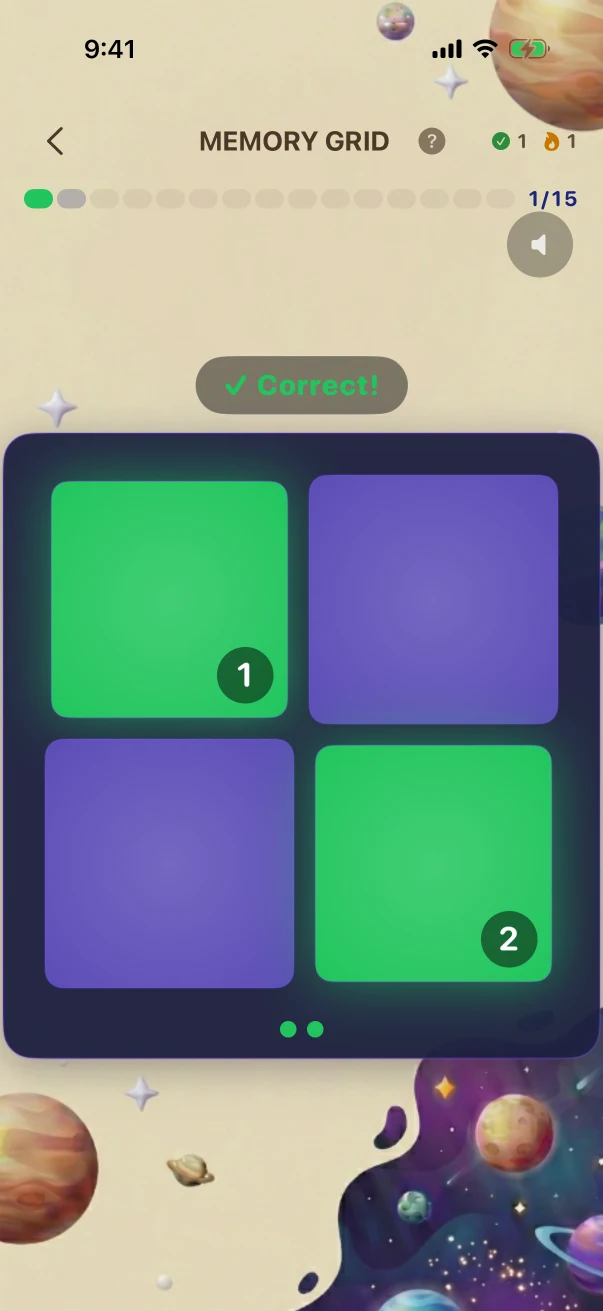
This example stays the same on the website so you can compare it. The app creates new problems during play.
All 5 formats, each with an early and later production state
Every comparison uses an app-created trial at the stated level. Forward and Reverse remove visible supports. Pattern Recall, Missing Tile, and Sequence Sort keep their response rule while production raises recall load, grid density, or presentation speed.
Forward recall
Watch positions flash one at a time, then tap the same route in the same order.
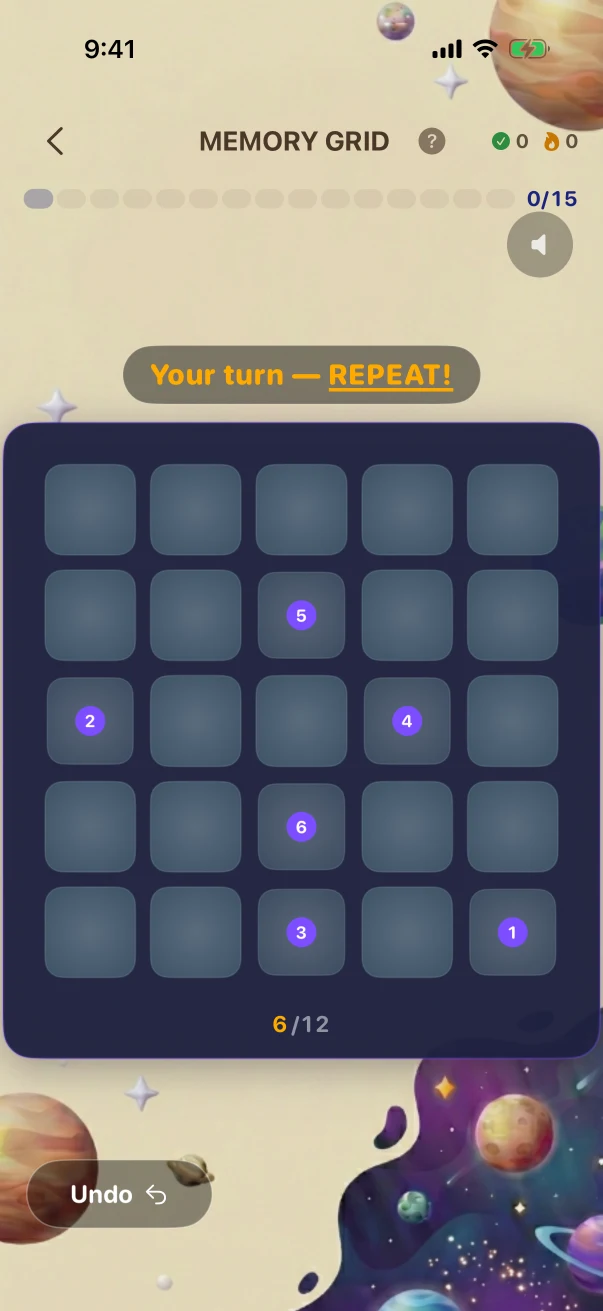
Two tiles on a bold 2-by-2 grid with route-trace and replay support become 12 tiles on a neutral 5-by-5 grid with both supports removed.
Forward recall · Later challenge · Level 85 The numbered or highlighted items show the child's response so far; the task is still in progress.
Forward recall · Later challenge · Olympiad / Honors Synthesis · Level 85 of 85
- What the child is solving
- Forward Recall
- What counts as correct
- The numbered or highlighted items in the phone show the accepted visual or ordered response.
The numbered or highlighted items show the child's response so far; the task is still in progress.
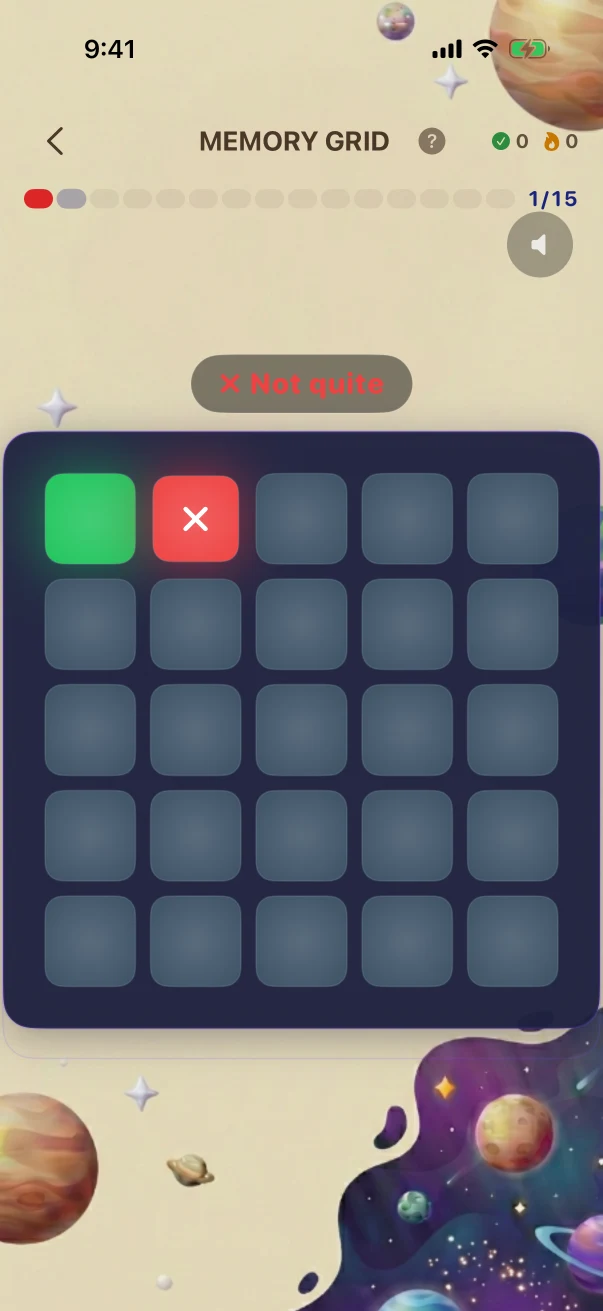
The correction stays tied to the same grid
This Level 85 Missing Tile trial shows the selected production grid and its exact wrong-answer correction. MemoryGrid does not add a worked explanation afterward.
- 1
Build a trial for the current level
The app chooses the grid, 12 study positions, a 0.5-second preview, and the one position to omit from the replay.
- 2
Compare the replay with the studied set
The child watches 11 positions replay and taps the one studied position that did not return.
- 3
Reveal the expected and wrong tiles
After a miss, the omitted position turns green and the selected wrong tile is marked on the unchanged grid before the app advances.
What genuinely changes across the full level path
The comparisons add new rules, operations, representations, interactions, and reasoning steps. Larger numbers or longer item lists alone are not treated as proof that a challenge is harder.
Start with a supported two-tile route
The Level 1 example uses a 2-by-2 grid, bold color, a brief numbered route trace, and one pre-answer replay.
Hold a dense visual snapshot
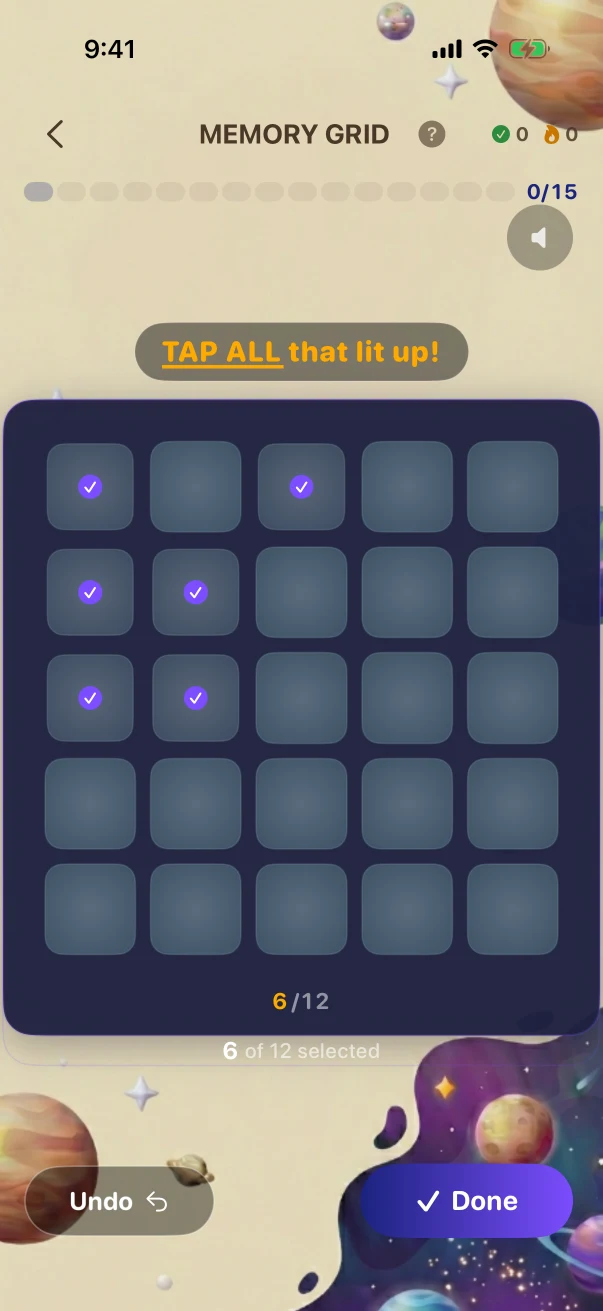
The Level 85 Pattern Recall example asks for 12 positions on a neutral 5-by-5 grid; selection order does not matter.
Compare a full pattern with an incomplete replay
The Level 85 Missing Tile example studies 12 positions for 0.5 seconds, then omits exactly one from the replay.
Reorder number-position bindings
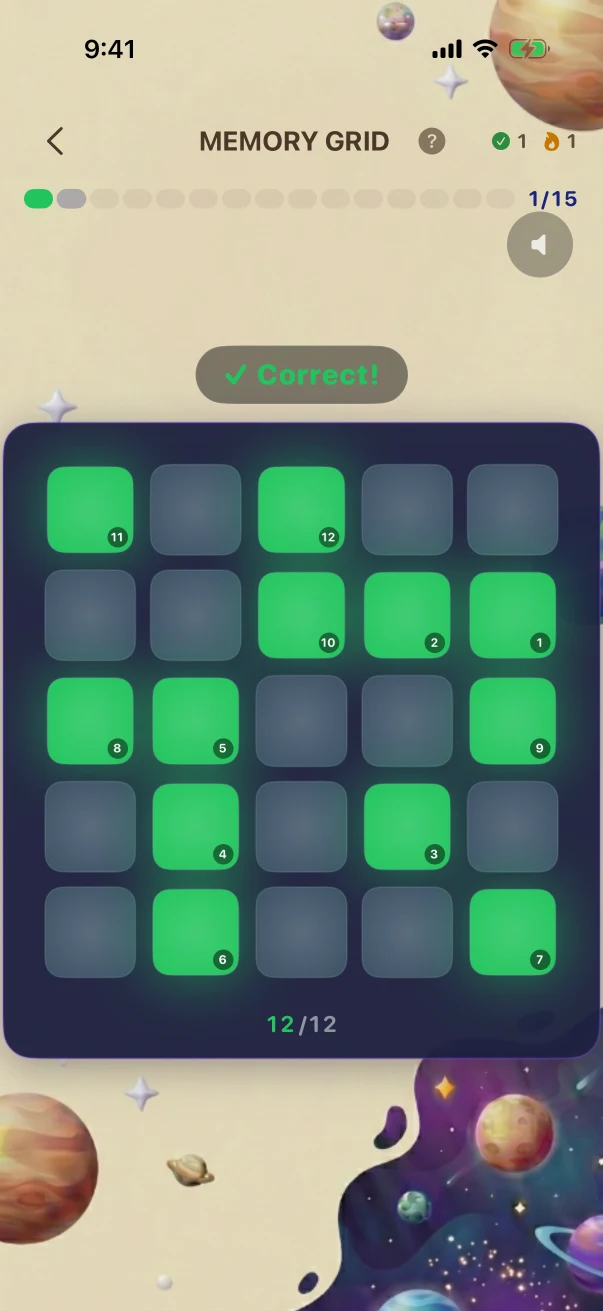
The Level 85 Sequence Sort example binds 12 numbers to positions at 275 milliseconds per tile. The sorting rule itself is unchanged from Level 56.
What the child is practising in the visible task
These are bounded practice goals tied to the actions shown above, not promises that one game replaces teaching or proves mastery.
Remember a spatial route
Forward Recall practises retaining where tiles appeared and reproducing the route in the same order.
Transform what was remembered
Reverse Recall and Sequence Sort require the seen positions to be reorganised before tapping.
Compare complete and incomplete sets
Pattern Recall rebuilds a snapshot, while Missing Tile compares that studied set with a replay containing one omission.
Fixed website examples, fresh app practice
The iPhone screenshots in this guide show reviewed examples checked against the app's current problem and answer rules. Use the controls to compare exact app states; the screenshots stay fixed so families can inspect them. At launch, the app will create new practice at the child's own level. Viewing this guide does not change app progress or earn anything toward a Screen Time unlock.
Daily browser game
A separate limited browser puzzle. It is not a generated app session that follows the child's full 85-level progression, and it awards no access points.
Try today's browser gameFull Braincove app at launch
Fresh MemoryGrid trials follow the child's level and the formats available there. A normal session uses a subset of the formats currently available at that level. Parents can change the number of trials and choose whether eligible completed app sessions contribute toward the Screen Time unlock rules they set. Core practice can continue through a temporary connection gap; family sync, Daily, homework, and cross-device updates still need connectivity.
Get the app launch email